


Drawings, specifications, work instructions, quality procedures, certificates: a manufacturer runs on documents, and their volume keeps growing. A document management system (DMS) uses software to control every step of a document’s life: creation, capture, indexing, review, approval, distribution, and archiving. Document management software first appeared in the 1980s, as computers multiplied the number of digital documents. Today, for manufacturers, it’s a direct lever on productivity, quality, and compliance.
📌 TL;DR
- A DMS controls documents from creation to approval, distribution, and archiving.
- Manufacturers need one to manage growing volumes, regulations, and remote collaboration.
- Key features include version control, approval workflows, access rights, and search.
- A DMS built into a PLM like Aletiq links documents to the products they describe.
What is a document management system
A document management system (DMS), also called electronic document management (EDM), is software that stores, organizes, and controls a company’s documents throughout their lifecycle. It replaces shared drives, email attachments, and paper binders with one secure repository where every document has a clear version, status, and owner.
In manufacturing, document management goes beyond office files. It covers engineering documents (drawings and specifications), production documents (work instructions and routings), and quality documents (procedures, certificates, and inspection reports), all of which change regularly and must be traceable.
Why manufacturers need a document management system
The amount of data companies handle has exploded. IDC’s Data Age 2025 study, sponsored by Seagate, projected that the global datasphere would grow from 33 zettabytes in 2018 to 175 zettabytes in 2025, more than 5 times in seven years. Manufacturers feel this growth directly, for three reasons:
- More complex products and organizations: more product variants, more partners, more layers of decision-making.
- More collaboration across the value chain: co-design and subcontracting multiply the documents shared with suppliers and customers.
- Stricter regulations: quality, safety, and traceability standards set tighter rules for how manufacturers manage their documentation.
Two more trends add pressure. Remote and hybrid work require tools accessible from anywhere, and rising cyber threats make document security a priority. As a result, manufacturers are adopting document management software to gain agility.
What are the key features of a document management system
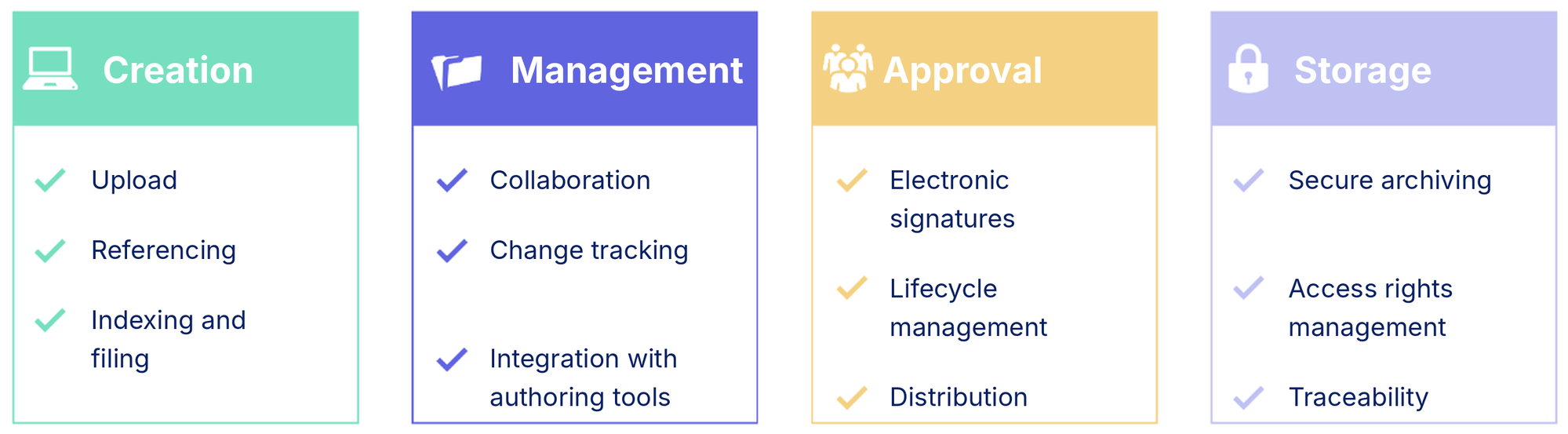
A DMS automates most of the work around documents. The core features to expect:
- Centralized repository: one secure location for all documents, accessible to every authorized user.
- Version and revision control: everyone works on the released version, and every earlier version stays archived.
- Indexing and search: metadata and full-text search find any document in seconds.
- Approval workflows: documents follow a defined review and approval chain, with electronic signatures.
- Access rights: each user sees and edits only what concerns them.
- Distribution: the right document reaches the right team or workstation automatically when it’s released.
- Audit trail: every action (creation, change, approval, deletion) is logged with who did it and when.
- Secure archiving: documents are retained and backed up for the required period.
How to implement a document management system
Many manufacturers see the value of document management but hesitate because the project looks complex. A structured approach keeps it manageable. It follows four steps:
- Define your needs: map how documents flow today, identify the pain points, and write them into a requirements document.
- Set your selection criteria: ease of use, deployment speed, flexibility, scalability, and total cost of ownership.
- Implement the software: define the target model, configure the solution, migrate your existing documents, and train users. Most companies need support from the vendor or an integrator for this step.
- Measure ROI: check whether you met your objectives, and identify the next improvements to keep progressing.
Migration doesn’t have to drag on. Moria, a medical device manufacturer, loaded about 12,000 documents and 10,000 SolidWorks files into Aletiq in 4 weeks.
What is the ROI of a document management system
Time and productivity gains
A DMS frees up hours for high-value work. According to McKinsey, employees spend about 1.8 hours a day, roughly 9 hours a week, searching for and gathering information. A DMS also improves collaboration and automates key processes such as approval workflows, changes, and distribution.
The impact is measurable: LISI Aerospace’s teams spend 80 % less time searching for data since centralizing their technical documents in Aletiq.
Regulatory compliance
Quality, safety, and traceability standards (ISO 9001, AS9100, ISO 13485, FDA 21 CFR Part 11) keep getting more demanding. A DMS manages the applicable documents, tracks every change, reduces risk, and keeps you audit-ready.
Security and confidentiality
Cyber risks push companies to secure their documents. A DMS protects critical data with granular access rights, secure storage, and replicated backups.
Document management system vs. PLM: which do you need
A standalone DMS manages documents. A PLM manages products, along with all the documents, BOMs, and changes attached to them. For manufacturers, that difference matters: a drawing or a work instruction only makes sense in the context of the product version and configuration it describes.
At Aletiq, we believe manufacturers shouldn’t have to choose between a DMS and a PLM. Aletiq includes document management natively: every document lives alongside the product it belongs to, with version control, approval workflows, and full traceability. It covers every document type and technical process, from design to manufacturing and quality, and it’s simple to use and quick to deploy.
Getting started with document management
A document management system gives manufacturers control over the growing volume of documents they produce, cuts the time teams waste searching for information, and keeps them audit-ready. Start by mapping where your documents live today and where errors happen, then choose a solution that connects documents to your products. Want to see how Aletiq manages your technical documents? Book a demo.
FAQ
What is a document management system
A document management system (DMS) is software that stores, organizes, and controls documents throughout their lifecycle: creation, review, approval, distribution, and archiving. It ensures everyone works on the right version and tracks every change.
What is the difference between EDM and DMS
EDM (electronic document management) and DMS (document management system) refer to the same thing: software for managing digital documents. DMS is the more common term in the US, while EDM is more common in Europe.
What are the benefits of a document management system for manufacturers
A DMS saves time spent searching for documents, reduces errors from outdated versions, and simplifies compliance with quality standards. It also secures sensitive technical data with access rights and backups.
What is the difference between a DMS and a PLM
A DMS manages documents, while a PLM manages products and all the data attached to them, including documents, BOMs, and engineering changes. Many PLMs, including Aletiq, include document management natively.
How long does it take to implement a document management system
It depends on the volume of documents to migrate and the number of users. Cloud solutions typically deploy in a few weeks. For example, Moria migrated about 12,000 documents into Aletiq in 4 weeks.


