


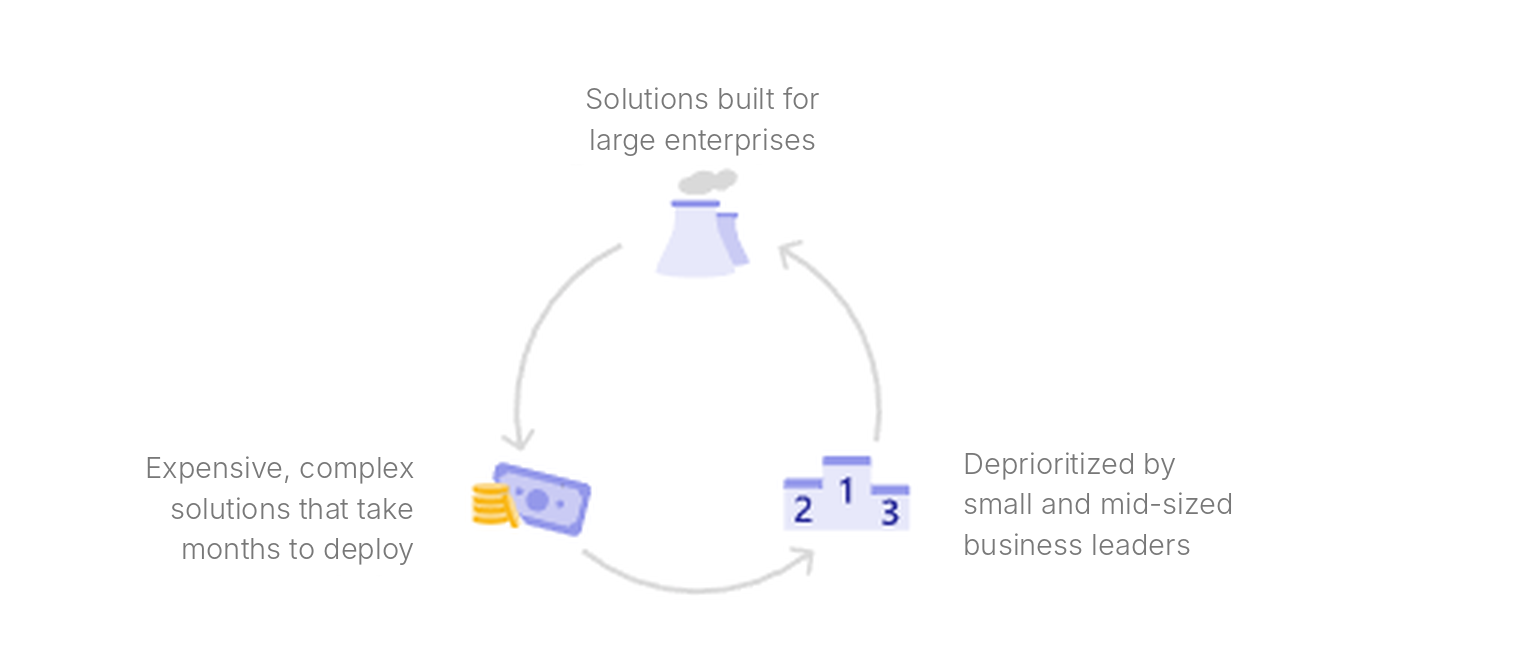
The digital transformation of industry must absolutely include the fabric of SMEs and ETIs that constitute the heart of the French industrial sector. However, providers of Industry 4.0 solutions often favor large groups and offer products that are too expensive and too complex for SMEs. Faced with this observation, some young digital companies have recently begun to tackle the problems of industrial SMEs.
Industrial SMEs are slow to start their digital transformation
France is positioned at 15th European ranking concerning the digital transition of industrial SMEs and ETIs. Change is difficult in the industry: assets with a long life cycle, quality/compliance requirements, pressure on margins do not encourage people to think outside the box and to innovate. Moreover, medium-sized businesses face other constraints:
- Industry 4.0 solution providers target large industrial groups and develop products that are too complex for SMEs.
- The cost of transformation is too high with on the one hand the too high cost of the systems (software licenses, updates, maintenance...) and on the other hand the costs of change management (team training, change support...)
- Leaders are prioritizing investments in industrial capabilities at the expense of new tools, hoping that the digital transition will take place under the mandate of their successors.
And yet, industrial companies that do not start their digital transformation will no longer be competitive in the medium term. The increasing complexity of products, the strengthening of quality requirements, and the increased need for traceability require optimized operating methods. Engineers, business managers and production technicians will no longer be able to spend their time on administrative tasks or document management with low added value. These must be automated in order to refocus teams on their core business. This will make it possible to reinforce the attractiveness of these positions and to make teams' work more effective.
PLM: the preferred tool for changing corporate culture
Jobs in the manufacturing industry have become incredibly complex and the trend will increase even more, driven by:
- The complexity of products: number of parts, sensors and embedded intelligence etc.
- The complexity of manufacturing processes: multi-trades, supplier-customer co-development, multi-site manufacturing, etc.
- The development of services based on product information: maintenance, continuous improvement, etc.
- The increase in regulatory, quality and traceability constraints
This new complexity is an opportunity for French industrial SMEs that want to differentiate themselves from low-cost countries. The implementation of new operating methods will make it possible to gain in productivity without investments in the production tool.
One of the tools that have proven their worth among large industrial groups is the product lifecycle management (PLM) solution. These platforms are used to share a single repository of product information within the company and to track associated processes. Among other things, they make it possible to simply manage configurations, maintenance requests or even a request for a customer to change the design. Design office engineers, quality teams and after-sales service thus saving precious time.
PLM, inaccessible to SMEs until today
Major software publishers have historically worked with major accounts for which they develop and deploy very expensive solutions:
- Over-specific implementation making it impossible to migrate to another software publisher
- Sprawling products involving hours of training before being able to perform the simplest operation
- Interfaces specific to a problem but not transposable to the multiple scenarios encountered
- Deployment requiring hundreds of hours of consulting and numerous developments before having a functional solution
This has resulted in PLM solutions being confined to multinationals. Medium-sized businesses couldn't afford it.
The online PLM solution
By developing SaaS (Software as a Service) solutions, new software vendors have enabled businesses to eliminate deployment costs, simplify solutions and simply interconnect the various platforms.
The user has access to software accessible from his browser, with a simple and readable interface and whose evolutions are deployed regularly and at no additional cost.
Billing is done in the form of a monthly subscription, without commitment and with simple means of backing up and restoring data in the event of termination of the service.
These innovations in the way of designing and selling software solutions make it possible to make digital industry tools accessible to SMEs and ETIs, more necessary than ever to remain competitive at the time of the 4th industrial transformation.


