


For medical device manufacturers, regulatory compliance controls everything: market access, legal liability, and patient safety. In Europe, that framework is the Medical Device Regulation (EU) 2017/745, known as the MDR. It applies to every company that designs, manufactures, imports, or distributes medical devices on the EU market, including US manufacturers exporting to Europe. The final transition deadlines arrive in 2027 and 2028, and many manufacturers are still racing to get there.
📌 TL;DR
- The EU MDR (2017/745) governs medical devices sold in the EU and replaces the MDD.
- It tightens classification, clinical evidence, technical documentation, and post-market surveillance.
- Legacy devices must transition to the MDR by December 2027 or December 2028.
- A PLM like Aletiq centralizes technical files and traces every change for audits.
What is the EU MDR 2017/745
The MDR (Medical Device Regulation, EU 2017/745) is the European Union’s regulation on medical devices. The EU adopted it in 2017 to harmonize practices across member states and raise the bar on safety, beyond what the ISO 13485 quality management standard alone requires.
The MDR pursues three goals:
- Higher quality, safety, and reliability, with stricter controls on high-risk devices
- More transparency for patients and healthcare professionals, through a unique device identifier and a European database
- Stronger post-market surveillance, based on real-world performance data collected by manufacturers
Notified bodies assess compliance by reviewing your risk management system, quality management system, and technical documentation. Manufacturers based outside the EU, including US companies, must also appoint an EU authorized representative.
What changed from the MDD to the MDR
The MDR replaces two directives that had been in place for about 25 years: the Medical Device Directive (MDD, 93/42/EEC) and the Active Implantable Medical Device Directive (AIMDD, 90/385/EEC). The goal: a more robust, transparent, and predictable framework that still supports innovation.
The six main changes:
- Classification rules changed for classes I, IIa, IIb, and III, and some devices moved to a higher class.
- Requirements for clinical investigations and post-market surveillance are stricter.
- Technical documentation requirements are more extensive.
- Every manufacturer must designate a person responsible for regulatory compliance.
- The roles and obligations of economic operators (importers, distributors, authorized representatives) are clearly defined.
- A Unique Device Identification (UDI) system improves traceability.
UDI and EUDAMED: how the MDR improves traceability
The UDI is a unique identifier assigned to each medical device. It tracks the device across its lifecycle, secures the supply chain, and makes recalls faster after a safety incident. It has two parts:
- UDI-DI (Device Identifier): identifies the device model
- UDI-PI (Production Identifier): identifies the production unit, with lot number, serial number, and manufacturing date
The MDR also requires manufacturers to register device information in EUDAMED, the European database on medical devices. Since May 28, 2026, using the first four EUDAMED modules (actor registration, UDI and device registration, notified bodies and certificates, and market surveillance) has been mandatory.
What are the EU MDR transition deadlines
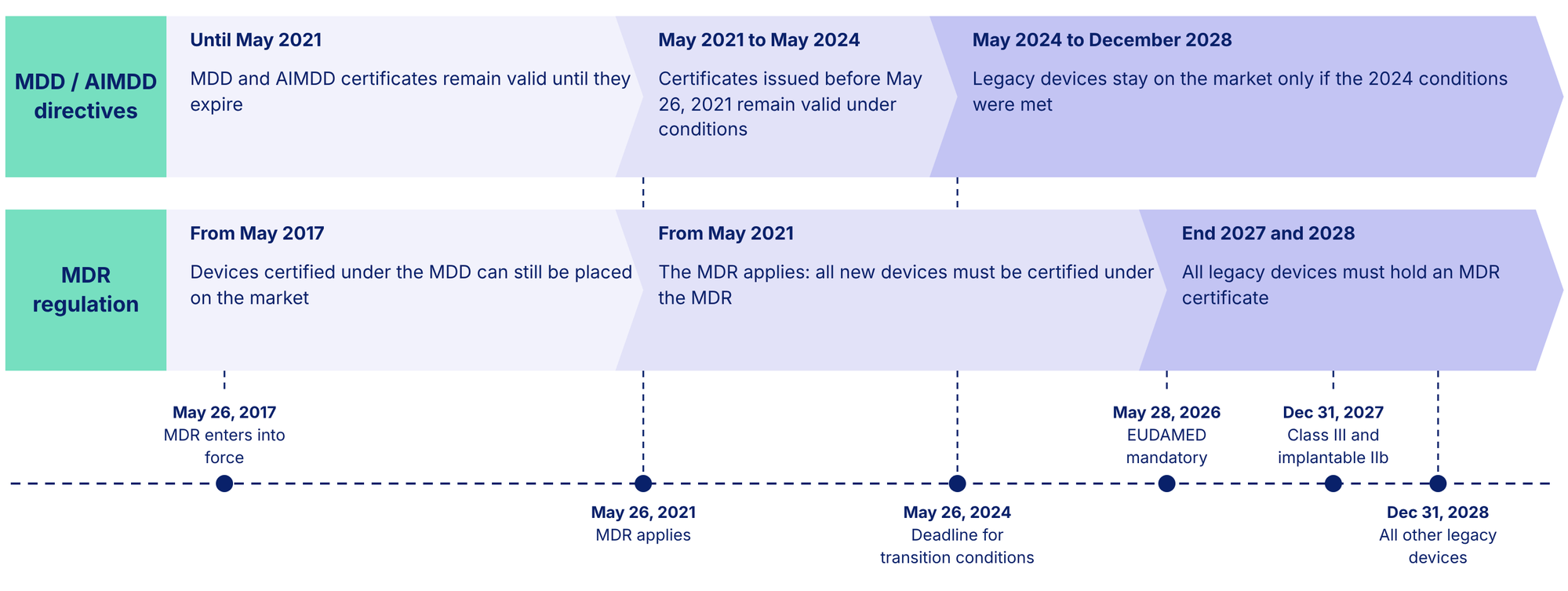
The MDR rollout has stretched over nearly a decade:
- May 26, 2017: the MDR enters into force.
- May 26, 2021: the MDR applies, after a one-year delay due to COVID-19.
- May 26, 2024: deadline for manufacturers of legacy devices to have an MDR-compliant quality management system and to have applied to a notified body.
- September 26, 2024: deadline to sign a written agreement with a notified body.
- May 28, 2026: use of the first four EUDAMED modules becomes mandatory.
- December 31, 2027: end of transition for class III devices and most class IIb implantable devices.
- December 31, 2028: end of transition for other class IIb devices, class IIa devices, and class I devices that are sterile, measuring, reusable surgical, or up-classified under the MDR.
Regulation (EU) 2023/607 introduced these extended 2027 and 2028 deadlines. They apply only to legacy devices whose manufacturers met the 2024 conditions and haven’t significantly changed the device’s design or intended purpose. Devices that missed those conditions already need full MDR compliance.
On December 16, 2025, the European Commission proposed a targeted revision of the MDR to reduce administrative burden. The proposal includes removing the 5-year limit on certificate validity, allowing more remote audits, and lightening some reporting obligations. As of this writing, the Parliament and Council are still reviewing it, so plan your compliance around the current rules.
How PLM software supports EU MDR compliance
The MDR is a major challenge for the entire medical device supply chain. Manufacturers must compile clinical evidence, maintain complete technical documentation, run a quality management system, and trace every technical change throughout the device lifecycle (MDR Article 10(9)).
Compliance doesn’t end with a notified body certificate. It’s an ongoing process that demands rigorous documentation, flawless change traceability, and a quality management system maintained year after year. Manufacturers still running on spreadsheets and shared folders hit a wall quickly.
At Aletiq, we believe MDR compliance should be a by-product of how your teams work every day, not a documentation sprint before each audit. Aletiq’s PLM addresses three core MDR needs:
- Centralized technical data: technical files (DHF, DMR, DHR), CAD files, BOMs, and quality documents in one source of truth
- Configuration and change control: every engineering change goes through impact analysis, an approval workflow with electronic signatures, and complete history
- Quality management system support: procedures, reviews, and records structured and auditable
Moria, a French manufacturer of ophthalmic microsurgery instruments, uses Aletiq to manage its technical documentation under the MDR. Less than 6 months after deployment, all its regulatory files were up to date with the new regulation. Impact analyses that used to take weeks now take seconds. Read the Moria case study.
Selling in the US as well? The FDA’s requirements follow the same logic of document traceability and change control. Read our guide to FDA 21 CFR Part 11.
Preparing for the 2027 and 2028 MDR deadlines
The MDR has reshaped the European medical device market. With the final transition deadlines approaching and notified bodies under heavy demand, manufacturers that structure their technical documentation and change processes now will reach compliance with far less stress. Start by auditing where your technical files and change records live today, then centralize them in a system that keeps them audit-ready by default.
Want to see how Aletiq keeps your technical files MDR-ready? Book a demo.
FAQ
What is the EU MDR 2017/745
The EU MDR is the European regulation that governs the design, manufacturing, and marketing of medical devices in the EU. It replaces the MDD and AIMDD directives and strengthens requirements for technical documentation, traceability, and post-market surveillance.
Who needs to comply with the EU MDR
Every manufacturer, importer, and distributor that places medical devices on the EU market must comply. Manufacturers outside the EU, including US companies, must also appoint an EU authorized representative.
What is the difference between the MDR and the MDD
The MDR is much stricter than the MDD. It tightens classification rules for high-risk devices, requires more robust clinical evidence and technical documentation, introduces the UDI system, and makes registration in EUDAMED mandatory.
When is the EU MDR deadline
The MDR has applied since May 26, 2021. Under Regulation (EU) 2023/607, eligible legacy devices can stay on the market until December 31, 2027 (class III and most implantable class IIb) or December 31, 2028 (other class IIb, class IIa, and certain class I devices), if the manufacturer met the 2024 conditions.
What is UDI under the MDR
The UDI (Unique Device Identification) is a unique identifier assigned to each medical device. It combines a device identifier (UDI-DI) for the model and a production identifier (UDI-PI) with lot or serial number and manufacturing date. It traces devices across the supply chain and simplifies recalls.
How does PLM help with MDR compliance
A PLM centralizes technical files, quality documents, and change records in one structured, auditable system. It manages configurations, approval workflows with electronic signatures, and complete change history, which simplifies notified body audits.


