


Technical product data passes through dozens of hands before it reaches the shop floor. Without control, the same bad habits keep causing errors, approval delays, and avoidable nonconformities: CAD files modified without traceability, BOMs out of sync, drawings emailed with no version control. Product data management (PDM) solves these problems by centralizing, organizing, and securing all product definition data, from 3D CAD models to BOMs, specifications, and quality documents. It becomes the single reference point for every team, from engineering to production.
📌 TL;DR
- PDM software centralizes CAD files, BOMs, drawings, and specs in one secure vault.
- It controls versions, access rights, approvals, and engineering changes.
- PDM covers design data, PLM covers the full lifecycle, and ERP runs operations.
- Platforms like Aletiq include PDM natively, so you never migrate to PLM later.
How does PDM software work
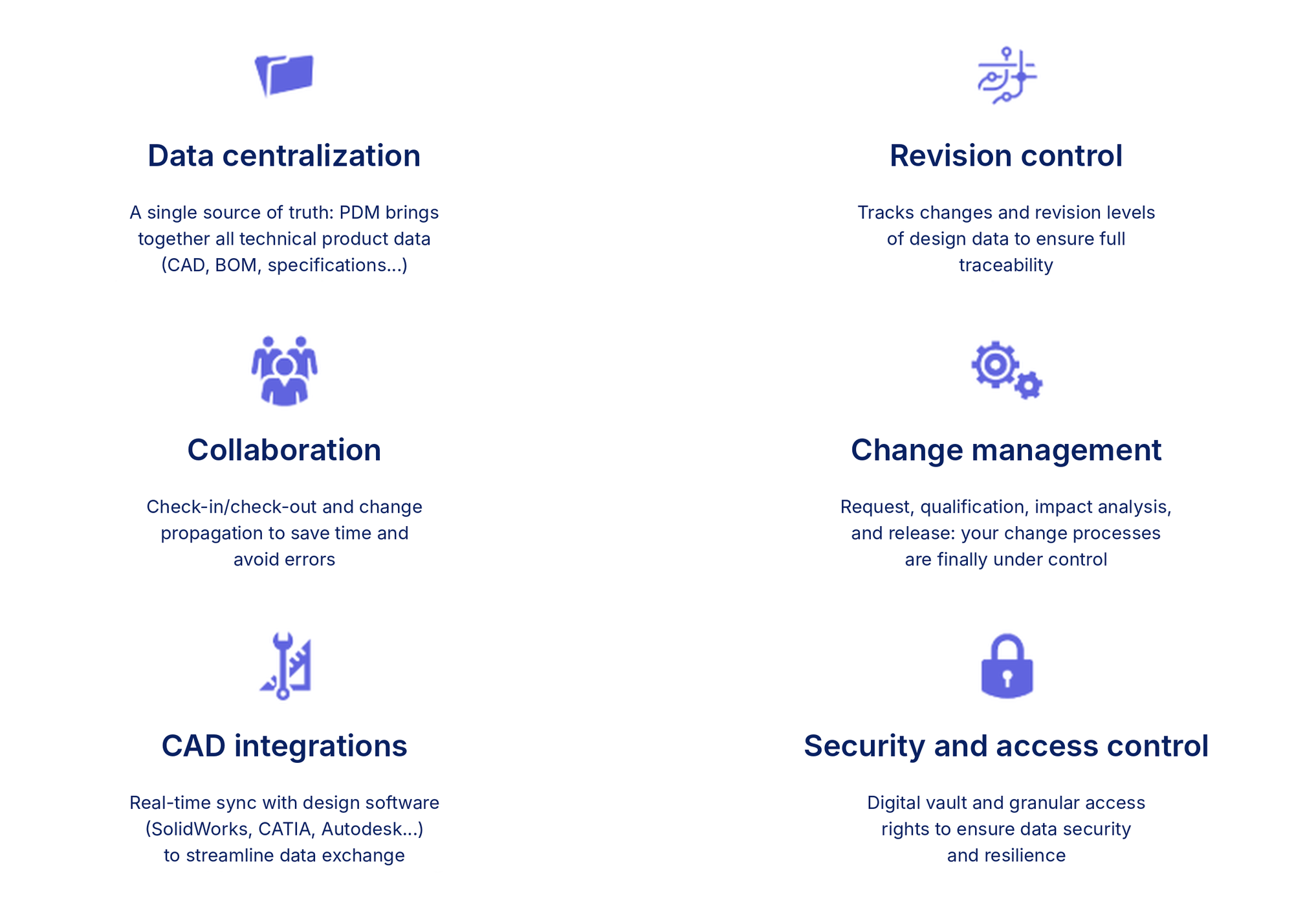
A PDM acts as the single source of truth for product definition data. Five core functions manage each file throughout its life in the company:
- Revision and version control: everyone accesses the released version, with no ambiguity.
- Check-in/check-out: two people can’t edit the same file at once, which prevents conflicts and lost work.
- Approval workflows: documents follow a defined review chain, with electronic signatures and full traceability of who approved what.
- Access rights: each user in engineering, quality, or production sees and edits only what concerns them.
- Engineering change management: change requests, impact analysis, and release follow a structured process, with complete history.
What are the benefits of PDM
Faster development cycles
Every hour spent hunting for a file version, checking whether a BOM is current, or chasing an approval stuck in an inbox is an hour not spent designing. A PDM removes that friction, shortens design cycles, speeds up iterations, and gets products to market sooner.
Better collaboration between teams
Design data flows to manufacturing engineering, quality, purchasing, and production. Without structure, it travels through email and messy shared folders. A PDM gives every team one shared space where it finds the data it needs, in the released version, without asking anyone.
Traceability and compliance
In regulated industries such as aerospace, medical devices, and automotive, traceability is mandatory: every change documented, every approval recorded, every version archived. A PDM handles this natively (who changed what, when, why, and through which approval path), so your audit data is always available and structured.
Protection of your engineering know-how
Technical product data is intellectual property. Stored on individual laptops or uncontrolled local servers, it’s exposed to accidental loss, unauthorized access, and leaks to competitors. A PDM centralizes it in a secure environment, with granular rights by user, department, and project.
Fewer errors and less rework
Machining a part from an obsolete drawing, ordering parts from a wrong BOM, applying an outdated quality procedure: each error costs time and material, and sometimes triggers a customer nonconformity. A PDM cuts these risks because the released data is always clearly identified.
The impact is measurable. At LISI Aerospace, more than 3,000 users rely on Aletiq as their single source of truth for technical data, spending 80 % less time searching for data, and they now process product changes 3 times faster.
PDM vs. PLM vs. ERP: what’s the difference
Most manufacturers run all three. They complement each other rather than compete, and understanding each scope is the key to a coherent information system.
PDM: design data
PDM focuses on engineering data: CAD files, BOMs, drawings, and specifications. It centers on the design phase and answers one question: what is the exact, approved definition of this product right now?
PLM: the full product lifecycle
PLM (product lifecycle management) covers the product’s entire life, from initial requirements to end of life. It connects engineering, manufacturing engineering, production, quality, purchasing, and service. PDM tracks what changed in design files. PLM structures how and why those changes happen and keeps information continuous across departments.
PDM is often seen as a building block of PLM. At Aletiq, we believe running them as two separate tools no longer makes sense: Aletiq includes PDM natively, so engineering data and the full lifecycle live in one platform.
ERP: resources and operations
ERP (enterprise resource planning) manages company resources: inventory, purchasing, finance, production, and logistics. It consumes product data from the PDM or PLM to run operations, but it doesn’t create that data. A solid PLM and ERP integration prevents double entry and keeps the technical definition aligned with what the plant actually builds.
Which industries use PDM software
PDM started in heavy industry, but as products grow more complex, its use has spread. Any company that designs technical products, manages BOMs, and coordinates several teams around definition data can benefit from it.
Aerospace and defense
Aerospace and defense remain the most demanding industries. Products are complex, lifecycles are long, and regulations are strict (AS9100 in the US, EN 9100 in Europe). OEMs such as Airbus, Boeing, and Dassault Aviation require full traceability across their supply chain. Here, PDM is both a condition for market access and a performance tool.
Hutchinson’s aerospace site uses Aletiq to meet these OEM requirements and has cut industrialization cycles by 30 %. “We finally have the certainty that the released data is in the right place, at the right time,” says Alexandre Saude, Engineering Manager at Hutchinson.
Medical devices
The FDA (with the QMSR and 21 CFR Part 11) and the EU’s MDR demand rigorous document traceability at every stage of the lifecycle. Every change must be approved, archived, and defensible during an audit. A PDM structures these processes and simplifies audit preparation.
Automotive
Development cycles are short, volumes are high, and coordination between design, manufacturing engineering, and production is critical. A PDM keeps data in sync between engineering and plants, and supports IATF 16949 compliance.
Electronics and high tech
Products evolve fast, revisions are frequent, and BOMs can include hundreds of part numbers. A PDM keeps successive versions consistent and helps manage component obsolescence.
Special machinery and industrial equipment
Machines are often one-offs or built in very small series, which makes variant, configuration, and in-service change management complex. A PDM structures that complexity and lets teams reuse previous designs to speed up new projects.
How to choose PDM software
The PDM market is broad, and solutions vary widely in scope, deployment model, and implementation complexity. Choose based on your real needs, not a feature checklist.
CAD integration
This is the most immediate criterion. A PDM that doesn’t integrate with your CAD tools creates friction from day one. Check the connectors available for SolidWorks, CATIA, Creo, Inventor, NX, and others. The more native the integration, the less custom development you need.
Deployment model: cloud or on-premise
Cloud (SaaS) means faster setup, automatic updates, and access from any site. On-premise gives you full control over where data is hosted, which some regulatory or data sovereignty contexts require. For most small and mid-sized manufacturers, SaaS is the most pragmatic choice today.
Ease of adoption
A PDM only delivers value if your teams use it. Interface design, learning curve, and onboarding support are decisive. Teams work around an overly complex tool, and the benefits disappear.
ERP and business tool integration
A PDM becomes far more valuable when it connects to your ERP (to sync BOMs and item master data) and to your other business tools (to eliminate double entry). Evaluate the APIs and native integrations available.
Scalability to PLM
A design-focused PDM can hit its limits when you extend data management to manufacturing engineering, quality, and production. Some platforms combine PDM and PLM in one environment, which spares you a costly migration later. Factor this in from the start.
Deployment speed and support
Companies often underestimate the time between purchase decision and day-to-day use. Legacy solutions can take months, sometimes more than a year. Modern platforms like Aletiq get first teams operational in a few weeks, with dedicated support for configuration and training.
Why product data management can’t wait
Product data management looks secondary until problems become impossible to ignore: a defect traced back to an obsolete drawing, a nonconformity found during an audit, weeks spent reconstructing a change history. A PDM does more than fix these crises. It prevents them. For manufacturers whose products and teams keep growing in complexity, structuring design data is a basic operating requirement, not an optimization project.
Aletiq: PDM and PLM in one platform
Aletiq includes PDM natively in its PLM platform, so your teams manage design data and the full product lifecycle in one tool, with no migration as your needs grow. Aletiq connects to major CAD tools, your ERP, and your business applications without custom development. Access rights are configurable by user, department, and project, and approval workflows with electronic signatures are built in. The platform is ISO 27001 certified, and data is hosted on European servers and replicated across 6 separate infrastructures.
LISI Aerospace and Hutchinson use Aletiq to centralize their technical data and structure their processes. Want to see how it works with your CAD and ERP? Book a demo.
FAQ
What is PDM software
PDM software centralizes and organizes technical product data: CAD files, BOMs, drawings, specifications, and quality documents. It makes sure every user accesses the released version and keeps full traceability of changes and approvals.
What is the difference between PDM and PLM
PDM focuses on design data for engineering teams. PLM covers the entire product lifecycle and connects all operational teams, from engineering to quality and production. The two are complementary, and platforms like Aletiq combine both.
What is the difference between PDM and a shared drive
A shared drive stores files but doesn’t control access or changes. A PDM manages versions, statuses, access rights, and approval workflows. It knows which version is released, who changed it, when, and why.
What size of company needs PDM
PDM adds value as soon as several people work on CAD data and that data moves between teams. For mid-sized companies and large manufacturers, it’s generally a prerequisite for managing product data at scale.
How long does it take to implement PDM
It depends on the solution and how complex your organization is. Legacy tools can take months, while modern platforms like Aletiq get first teams operational in a few weeks, with structured support for configuration and training.
Can PDM integrate with an ERP
Yes, and it’s a key selection criterion. PDM and ERP integration syncs BOMs and item data, eliminates double entry, and keeps the technical definition aligned with production.


