


A field technician drives two hours to repair a machine and finds out on site that it runs a configuration nobody documented. A sales engineer spends 30 minutes hunting for component data buried in an outdated BOM. Both problems have the same cause: product data that stops at the engineering department’s door. A digital product passport fixes that by giving every unit you ship a complete, accessible record, from first CAD file to last maintenance visit. With the EU now making passports mandatory for some product groups, they’ve moved from nice-to-have to strategic for any manufacturer selling in Europe.
📌 TL;DR
- A digital product passport centralizes all data on a product across its lifecycle.
- It connects engineering, production, sales, and service teams around one record.
- A PLM like Aletiq is the natural source of truth for passport data.
What is a digital product passport
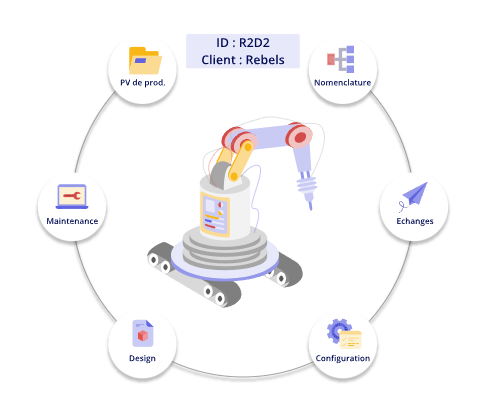
A digital product passport (DPP) is a structured digital record that centralizes a product’s information and processes across its entire lifecycle. Information covers CAD files, drawings, BOMs, configuration, production data, and quality records. Processes cover design, engineering changes, and maintenance.
At Aletiq, we see the digital product passport as the logical extension of PLM: PLM gives engineering a single version of the truth, and the passport carries that truth to every team and every unit in the field. Large OEMs pioneered the approach. Cloud PLM now makes it accessible to small and mid-sized manufacturers too.
How a digital product passport connects engineering, production, and service
PLM’s core benefit is one version of product data for design teams. The digital product passport extends that continuity downstream to production, sales, and maintenance.
Without it, critical data stays locked in engineering systems. Sales engineers can’t find the right BOM. Field technicians discover a machine’s configuration only when they open it up. With a passport, each team gets the data it needs (BOMs, CAD, configurations) the moment it needs it.
Why centralize a product’s full lifecycle history
A product lives through dozens of events after its design: supplier discussions on subcontracted parts, production release of a version, compliance testing, sale and shipment, engineering changes requested by customers, software updates, failures, and repairs.
A digital product passport captures each event with its documents and partner exchanges, giving you the full picture of the product’s life. The payoff is concrete:
- Your team finds a past supplier discussion on electric motor sizing and skips repeating the study for the next version.
- Your technicians pull design documents, user manuals, and maintenance history in seconds, and repair lead times drop.
One accurate, available record saves time internally and strengthens relationships with customers and suppliers.
How digital product passports improve installed base tracking
When you maintain the products you sell, you need a full view of your installed base. A digital product passport generated automatically for each unit makes fleet tracking far simpler.
You can filter units by shared characteristics and act on them:
- Find every unit with a defective component and organize a targeted recall.
- Select every product running a given software version to push an update or patch.
From the passport, your service team can contact the customer directly and schedule an on-site visit. Spotting a recall early also helps you manage the crisis and protect your brand’s reputation.
One of our energy customers cut the time to identify affected units in a recall from 3 days to 2 hours with Aletiq.
Using product passport data for continuous improvement
A digital product passport links data that used to live in separate silos: design documentation, production data, quality test results, maintenance history, and customer feedback. Because this data exists for every product you make, statistical analysis becomes simple.
You can compare a part’s reliability across manufacturing processes, or measure how often a software version fails on a specific hardware configuration. These insights shorten development cycles for new versions and bring real field feedback into engineering.
How digital product passports support predictive maintenance
Analyzing maintenance data across your fleet helps you anticipate failures and act before they happen, which raises equipment availability significantly. Your customers avoid downtime or keep it short.
A breakdown is usually bad news for a customer relationship. With predictive maintenance, it becomes a chance to show reliability: the customer plans around the intervention instead of suffering it.
Why PLM is the foundation of a digital product passport
A passport is only as good as the data behind it. If BOMs, configurations, and change history live in spreadsheets and email threads, the passport inherits those errors.
At Aletiq, we believe manufacturers should build their digital product passport on their PLM, not alongside it. Aletiq already holds the configuration-controlled product data a passport needs, and AI helps structure it and keep it current as products change. For the sustainability side of the passport, read our guide on tracking a product’s environmental footprint with PLM.
Getting started with your digital product passport
Some large manufacturers already run digital product passports, and EU regulation will make them standard practice. They centralize product data across the lifecycle, save engineering, production, quality, and service teams hours of searching, and give you a fleet-wide view that improves both products and customer relationships. For small and mid-sized manufacturers, they’re a direct path to competing with much larger players.
Start by auditing where your product data lives today, then centralize it in a PLM that can feed a passport per unit. Want to see how Aletiq builds a complete product record? Book a demo.
FAQ
What is a digital product passport
A digital product passport is a digital record that holds all the information about a product across its lifecycle: design files, BOM, configuration, production, quality, and maintenance data. Teams inside the company use it, and under EU rules, so can customers, recyclers, and regulators.
When will the digital product passport become mandatory
Under the EU Battery Regulation, battery passports become mandatory in February 2027 for EV, light transport, and industrial batteries above 2 kWh. Other product groups, starting with iron and steel, textiles, tires, and aluminum, follow through ESPR delegated acts between 2027 and 2030. Each act sets its own compliance date.
Do US manufacturers need a digital product passport
US manufacturers need one for products they sell in the EU once that product group falls under a delegated act. No federal US equivalent exists today. Many US companies still adopt passports for traceability, service, and recall management.
What information does a digital product passport contain
Content depends on the product group, but it typically includes a unique product identifier, materials and components, manufacturing data, compliance documents, and repair and recycling information. Internal passports also add CAD files, configurations, and full maintenance history.
What is the difference between PLM and a digital product passport
PLM manages product data during design and engineering, mostly for internal teams. A digital product passport carries that data forward for each unit across production, use, maintenance, and end of life. PLM is the source of truth, and the passport is how that truth reaches every stakeholder.


